

2026 is shaping up to be a pivotal year for the property sector.
Major reforms are underway, fiscal pressure is reshaping decision-making, and there is renewed political momentum to address long-standing system issues (an election year certainly helps with that).
This is where Property Council’s advocacy role matters most.
The advocacy team represent the full property ecosystem, bringing a broad, joined-up perspective to government and decision-makers. Where others are siloed, our approach is whole-of-sector, practical, and solutions-focused. We work constructively across political lines, engage early, and advocate consistently to deliver outcomes that support viable development and long-term consistent growth.
That approach is delivering results. In 2025, our Advocacy team (of 4!) delivered:
- 35 submissions to government
- 294 stakeholder meetings with politicians and other decision makers
- 28 media interviews
- more than 200 media mentions
We are trusted, well-established, and effective – and our influence continues to grow.
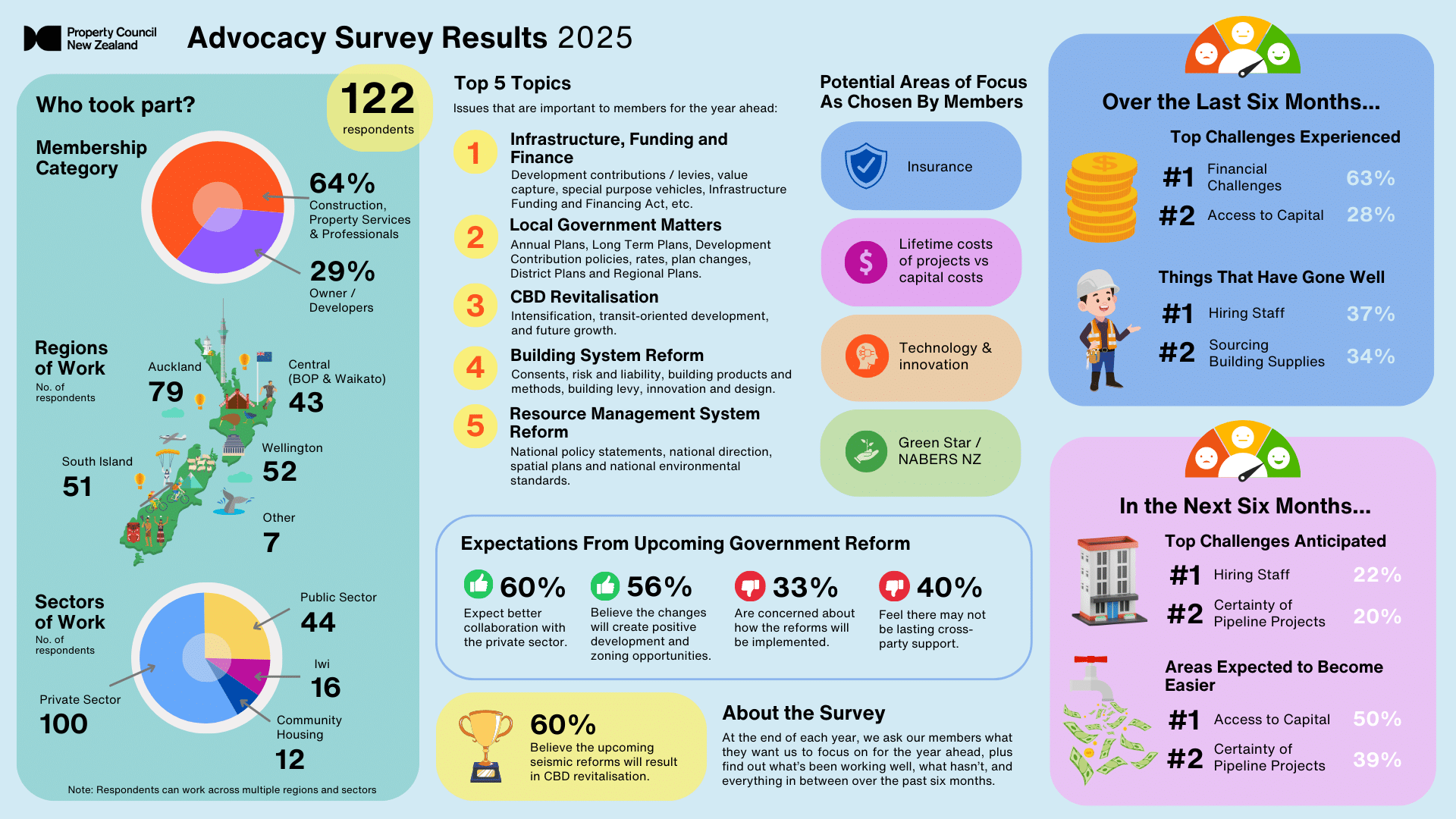
Setting the Agenda: Our 2025 Advocacy Survey
Just as importantly, our advocacy is member-led. At the end of each year, we ask members what they want us to focus on next. Our end-of-year 2025 Advocacy Survey across member regions, asset classes, and sectors, provides a clear mandate for the year ahead.
The results strongly align with the government reform agenda already underway and give us confidence we are focused on the right issues at the right time.
Below is a snapshot into what your priorities are for 2026 and what is happening in each space:
Infrastructure was the clear number one priority for members and with good reason.
Across the country, infrastructure assets are ageing, Council balance sheets are under pressure, and Government is moving quickly to address the infrastructure deficit. The National Infrastructure Plan, reforms to the Infrastructure Funding and Financing Act, and the introduction of development levies signal significant structural change.
While we support the intent to unlock funding and improve delivery, we are concerned about how development levies will replace the development contribution regime and potentially aggregate growth costs across wide urban areas, with implications for feasibility and investment decisions. Our focus in 2026 will be ensuring these reforms are fair, targeted, and support growth rather than suppress it.
This work is being led through our Development Levies and Infrastructure, Funding and Finance Taskforce, where we ask members what our positioning should be for our active engagement with officials, submissions, and direct ministerial engagement. Any Property Council member is welcome to join.
Local government reform is back firmly on the agenda, with rate caps, regional council reform, and tighter fiscal settings already taking shape.
As Council finances tighten, effective ring-fencing of funds, transparency, and adequate council capability will be critical. Poor implementation risks slowing delivery at a time when certainty and efficiency are most needed.
Property Council’s regional advocacy model is central here. We have four regional committees, led by members, who engage directly with councils and elected representatives. Our annual plan submission programme, commencing in March, will again see coordinated submissions to Tier One growth councils and selected Tier Two councils nationwide.
City centre performance remains a key concern – and a major opportunity.
Encouragingly, 60% of survey respondents believe upcoming seismic reforms from government will support CBD revitalisation. This is our most significant advocacy win of-late: seismic reform is estimated to save our sector $8.2 billion in remediation and demolition costs.
What began as a regional committee discussion evolved into a dedicated Seismic Strengthening Taskforce, years of sustained advocacy, and early engagement with Minister Chris Penk, the Minister for Building and Construction. This reform will materially improve reinvestment confidence in CBDs, and we will continue to advocate for intensification, transit-oriented development, and long-term certainty to support urban renewal.
Building system reform remains a priority for members, with strong support for the government’s proposed Building Consent System reforms.
In particular, the move toward proportionate liability reflects long-standing advocacy led through our Building Systems Taskforce. We look forward to seeing this change reflected in legislation, alongside other proposed changes expected in early 2026 and will focus on ensuring the reforms improve risk allocation, system efficiency, and innovation outcomes.
While another round of RMA reform may feel familiar, the current direction is more promising than previous attempts.
The proposed Planning Bill and Natural Environment Bill, released in December last year signal more streamlined consenting, clearer national direction, and reduced costs. The overhaul of the resource management system will have the potential to improve certainty, and support faster delivery of housing and infrastructure whilst also protecting the environment.
We are cautiously optimistic with the overall direction of reform and will focus our upcoming submission on ensuring that the new system is clear, workable, and delivers these intended outcomes in practice.
Advocacy that is informed by members
Our advocacy is built through 12 member taskforces, open to all members and designed to provide real-time feedback on significant legislation and policy reform. These groups ensure our positions are grounded in market reality and strengthen our credibility with decision-makers.

The Year Ahead: Shaping the Property Agenda in 2026

Policy Scorecard: Your membership at work

On the Move | January 2026

Building the Foundations for Future Communities at RESI26

Opinion | Are you leading from where you are?
